
A delayed airport pickup rarely looks like a transportation issue. It looks like poor judgment. For senior leaders, board members, and client-facing professionals, that is why an executive travel logistics guide matters – not as a convenience, but as a safeguard for time, reputation, and control.
Executive travel is different from ordinary trip planning because the margin for error is smaller and the cost of disruption is higher. One missed connection can derail a presentation, compress a negotiation window, or force an assistant to rebuild an entire day in real time. The right travel plan protects the schedule before the first wheel moves.
What an executive travel logistics guide should actually cover
A useful executive travel logistics guide is not a packing checklist dressed up as strategy. It should define how the trip will function on the ground, who is accountable at each step, and what happens when the original plan changes.
Most travel problems begin in the gaps between reservations. A flight may be confirmed, a hotel may be secured, and a meeting may be on the calendar, yet the traveler still loses time because no one clarified terminal pickup instructions, vehicle staging, route timing, security requirements, or the buffer between arrivals and appearances. Logistics is the discipline of closing those gaps.
For executives, the essential categories are straightforward. You need timing, vehicle fit, communication, contingency planning, and service standards. Miss one, and the rest of the itinerary becomes fragile.
Start with the schedule, not the vehicle
Many travelers think ground transportation begins with choosing a sedan or SUV. In practice, it begins with the day’s non-negotiables. What time does the executive need to be composed, not merely present? Is there a call that must happen in transit? Will there be luggage, staff, or security personnel? Is the traveler arriving from a long-haul flight and heading directly into a client-facing setting?
Those details shape every transportation decision that follows. A thirty-minute drive on paper may require fifty minutes in reality if there is airport congestion, credentialed entry, a downtown security perimeter, or a need for a discreet arrival point. In the Washington, DC region, this distinction matters even more when traffic patterns shift around events, motorcades, or peak government travel windows.
An executive itinerary should be built backward from the first immovable commitment. That means establishing the arrival-ready time, then layering in realistic drive time, airport exit time, baggage handling, and a contingency cushion. People who travel often sometimes resist buffers because they feel inefficient. Seasoned planners know the opposite is true. A narrow schedule creates downstream waste.
Build in the right amount of margin
Too much buffer can feel excessive. Too little can embarrass everyone involved. The right margin depends on context.
If the traveler is heading from Reagan National or Dulles directly to a high-stakes meeting, extra time is prudent because the cost of being early is low compared with the cost of arriving rushed. If the trip is a routine office transfer with flexible start times, the buffer can be tighter. The point is not to overbuild every move. The point is to match the margin to the consequence of delay.
Vehicle selection is about function and image
Luxury transportation should reflect the occasion, but function comes first. A premium sedan may be ideal for a solo executive with a light bag and a compact downtown schedule. A luxury SUV is often the better choice when there is additional luggage, multiple passengers, or a preference for a higher level of privacy and cabin space.
For teams, boards, wedding parties, or visiting delegations, a Sprinter van or executive shuttle can preserve cohesion and prevent the all-too-common problem of staggered arrivals. When people matter equally, shared timing matters too.
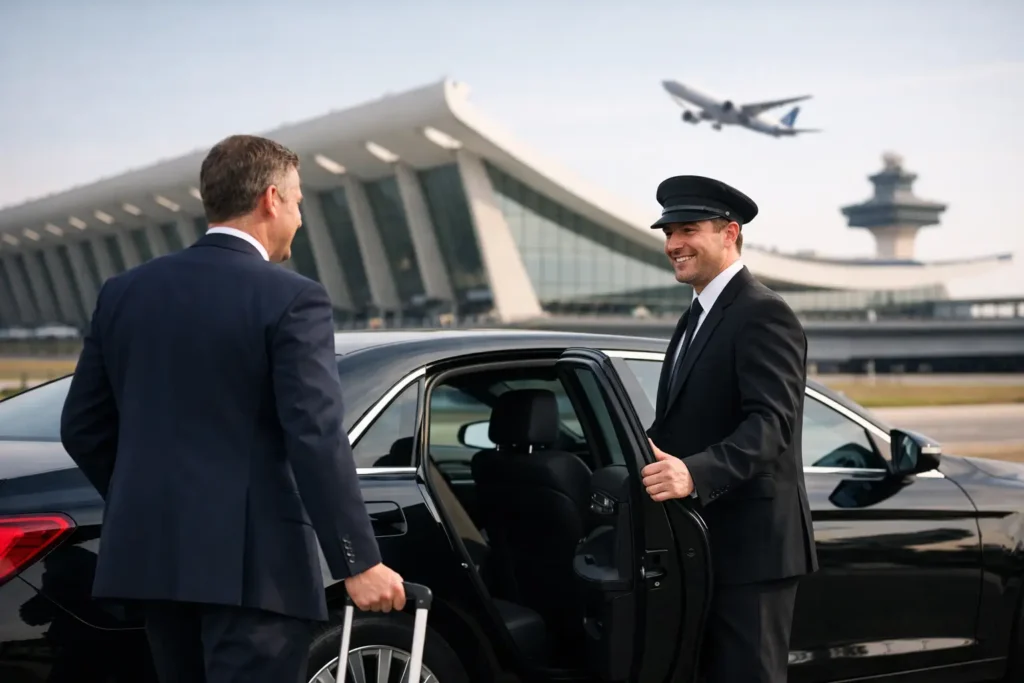
Image also has a legitimate role. An executive stepping out for an investor meeting, private event, or formal arrival should not be met with transportation that feels improvised. Your reputation travels with you. The vehicle, chauffeur presentation, and arrival experience all signal how seriously the moment is being handled.
Communication protocols prevent small failures from becoming public ones
The most polished transportation experience is often the one that required the least explanation on the day of service. That only happens when communication is set before the trip begins.
The traveler should know who the chauffeur is, how pickup will be handled, and what to do if plans shift after landing. The coordinator or assistant should know who has authority to approve changes, whether there are additional stops, and how to reach live support if the itinerary changes outside business hours.
This is where premium service separates itself from ordinary booking platforms. Technology can confirm a reservation, but it does not replace active oversight. Executives need direct communication, not guesswork. If a flight lands early, if a meeting runs late, or if the principal adds a second destination, the transportation plan should adjust without drama.
Share only the information that improves execution
There is a balance here. Over-communicating every detail to every person can create confusion, while under-sharing can create service mistakes.
The chauffeur needs operational facts: timing, pickup point, passenger count, luggage profile, destination sequence, and any access instructions. The traveler needs clarity and confidence. Internal stakeholders may need only the elements that affect the broader schedule. Discretion is part of logistics, not an afterthought.
Airport transfers deserve executive-level planning
Airport transportation is where many otherwise competent travel plans fail. The reservation may be made, but no one has mapped the arrival path. Which terminal? Curbside or meet-and-greet? Is the passenger checking bags? Are there VIP expectations? Is the pickup at a private terminal, commercial airport, or FBO? Those are not cosmetic details. They determine whether the handoff feels controlled or chaotic.
For business travelers, airport service should account for live flight tracking, realistic deplaning times, and clear post-landing instructions. The goal is to reduce decision-making after arrival. After a full travel day, an executive should not be sorting through texts, comparing pickup lanes, or calling to explain where they are standing.
This matters especially for arrivals into busy regional airports, where congestion can shift quickly and curb access may change by terminal. Precision protects the experience.
Contingency planning is the mark of a serious operation
The best-run trips are not the ones that go exactly as planned. They are the ones that remain composed when plans change.
An executive travel plan should account for common disruptions: delayed flights, meeting overruns, weather complications, road closures, and last-minute destination changes. It should also account for less common but high-impact issues, such as security adjustments, confidential passenger movement, or multiple stakeholders needing coordinated pickups.
This does not mean turning every reservation into a security exercise. It means deciding in advance how flexible the service needs to be and who is monitoring it. Same-day availability, live dispatch support, and chauffeurs trained to adapt matter because executive travel is rarely static.
There is always a trade-off. Highly rigid planning can keep costs predictable but leaves little room to maneuver. Highly open-ended service offers flexibility but may require stronger coordination and clearer approval lines. The right model depends on the stakes of the itinerary.
The service standard should match the traveler’s role
Not every VIP needs the same thing. A CEO on a press-sensitive visit may prioritize discretion. A law firm partner heading to court may prioritize timing above all else. A wedding couple may care most about presentation and calm. A corporate host receiving out-of-town guests may need transportation that reinforces the company’s standard before the first handshake.
That is why premium ground transportation should never feel generic. The service standard should reflect the role of the passenger and the significance of the occasion. Chauffeur conduct, vehicle condition, route planning, and responsiveness all contribute to that standard.
In the DMV, where diplomacy, corporate visibility, and formal events often overlap, that level of precision is not indulgence. It is professional discipline. Monarch Bus & Limo understands this well because executive travelers are not simply getting from point A to point B. They are preserving momentum, presence, and poise.
A better way to evaluate your travel plan
If you want to test whether your executive transportation is truly handled, ask a simple question: if one part of this day changes, does the rest still hold?
If the answer is no, the plan is too thin. If the answer is yes because the timing is realistic, the vehicle is appropriate, communication is clear, and support is available when the schedule moves, then the logistics are doing their job.
Luxury is not excess. At the executive level, it is control delivered with polish. When the ground plan is right, the traveler steps out collected, on time, and fully prepared for what matters next.
That is the standard worth reserving every time.
Keep Discovering
Ready to Ride, Anywhere in the DMV
Popular Services
Explore the Fleet
Service Areas

Luxury Chauffeur Service Near Me Guide
Dulles Airport Car Service Review