
A missed flight rarely begins at the gate. More often, it begins with a pickup scheduled too tightly, an underestimated security line, or a drive that leaves no room for the unexpected. So, when should airport car arrive? For most premium travelers, the proper answer is earlier than the minimum – with enough margin to protect the purpose of the trip, the people traveling, and the reputation attached to the arrival.
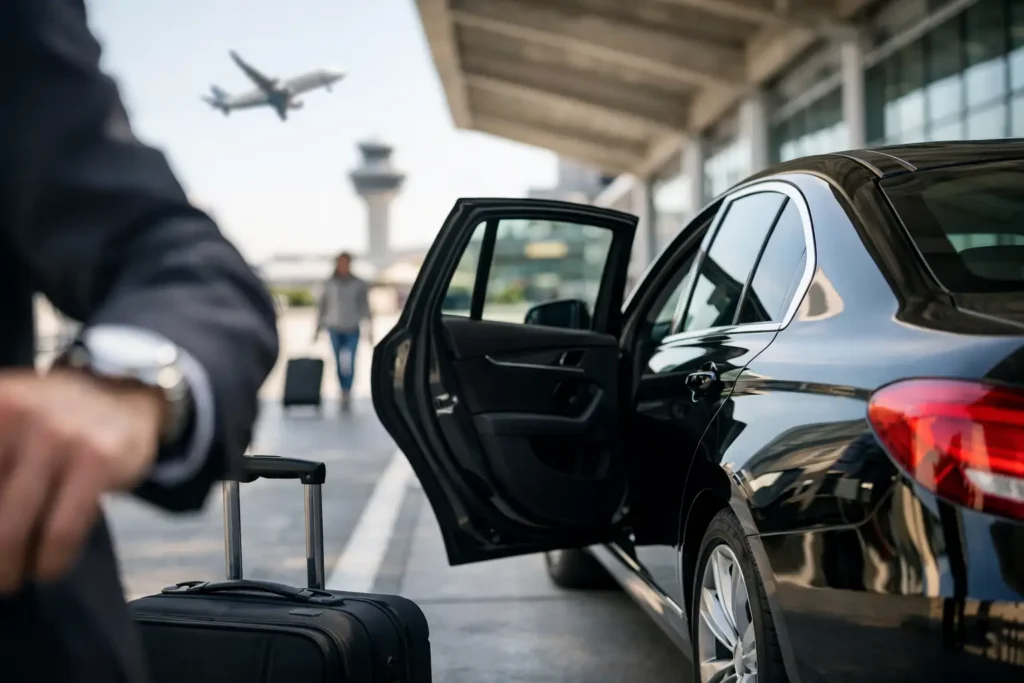
Airport transportation should never be treated as a casual estimate. An executive flying out for a board meeting, a family beginning an international holiday, and a wedding party departing after a formal celebration all face different demands. The right pickup time is not simply about distance from the airport. It is about creating a composed departure, even when traffic, weather, terminal congestion, or airline procedures change the plan.
When Should an Airport Car Arrive for Departure?
For domestic flights, a private airport car should generally arrive at your pickup location 15 minutes before the scheduled departure time. That does not mean leaving for the airport 15 minutes early. It means your chauffeur is positioned and ready before you are expected to step outside.
From there, build the itinerary backward. Airlines commonly recommend arriving at the terminal at least two hours before a domestic departure and three hours before an international flight. Those are sensible starting points, but they are not a complete transportation strategy. Add realistic drive time, a traffic buffer, and time for luggage handling, curbside access, and any final coordination before entering the terminal.
For an executive departing from Washington, DC, Northern Virginia, or Maryland, a practical rule is to allow at least 30 additional minutes beyond the map’s estimated drive time during ordinary travel periods. During weekday rush hour, major conventions, holiday weekends, or severe weather, a larger buffer is warranted. A refined journey has room for reality.
A dependable domestic-flight framework
If your flight departs at 10:00 a.m., plan to be at the airport by 8:00 a.m. If the drive normally takes 45 minutes, allow 60 to 75 minutes for the road. Your vehicle pickup should therefore be around 6:45 a.m. to 7:00 a.m., with the chauffeur arriving a few minutes before that scheduled pickup.
This timing may feel generous on a quiet morning. That is precisely the point. The value of a luxury airport transfer is not merely arriving eventually. It is arriving calm, collected, and prepared to move through the terminal without watching the clock.
International flights deserve greater protection
International departures introduce more variables: passport checks, document requirements, checked-bag deadlines, larger passenger volumes, and occasional terminal changes. Plan to reach the terminal three hours before departure as a baseline, then add drive-time protection based on the route and time of day.
For a 9:00 p.m. international flight from Dulles, arriving at the terminal by 6:00 p.m. is prudent. A traveler leaving downtown Washington during evening congestion may need a vehicle pickup well before 4:30 p.m., especially if there are multiple stops or significant luggage. The earlier pickup is not excessive. It is the difference between a rushed curbside drop-off and a departure that feels properly managed.
The Factors That Change Airport Car Timing
A polished itinerary should reflect the traveler, not a generic rule. The following factors most often justify an earlier vehicle arrival or departure.
Your airport and terminal
Reagan National Airport can be convenient for many DC travelers, but its proximity does not eliminate timing risks. Roadway traffic, terminal activity, and security volumes can shift quickly. Dulles Airport requires more driving time for many DMV locations and may involve a longer terminal journey, particularly for international travel.
The airport is only one part of the equation. Confirm the airline, terminal, flight type, and whether you are checking bags. A car service can plan a route with greater precision when the full itinerary is known.
Time of day and local conditions
A 5:30 a.m. departure from a suburban residence can look very different from a 5:30 p.m. departure during weekday traffic. In the DC region, a route that takes 35 minutes outside rush hour can require more than an hour when commuter patterns, incidents, or weather interfere.
Do not rely on an optimistic navigation estimate from the night before. The road conditions at the moment you travel are what matter. Reserve enough time for the drive to unfold without forcing a chauffeur to make up an unrealistic schedule.
Checked bags, special equipment, and group size
Travelers with carry-on luggage and expedited security access can move quickly. Those checking bags must respect airline cutoff times, which can be earlier than the boarding time shown on the ticket. Families traveling with car seats, strollers, ski equipment, or several large cases need more curbside and handling time as well.
Groups should add a meaningful buffer. Coordinating eight guests in a Mercedes Sprinter van is different from sending one executive in a sedan. The vehicle may be ready precisely on schedule, but every passenger must be ready to depart for the plan to hold.
The importance of what awaits you
Not every flight carries the same consequence. If you are flying to a routine personal engagement, the standard recommendation may be sufficient. If you are traveling for a client presentation, government meeting, investor dinner, wedding, or once-in-a-lifetime occasion, plan more conservatively.
Your reputation travels with you. When the purpose of the trip is high stakes, extra time is not an indulgence. It is professional insurance.
Arrival Pickups: When Should the Car Be Waiting?
For airport arrivals, the question changes. Rather than asking when the car should arrive at your home or office, ask whether it will be ready when you reach the designated pickup point.
A professional chauffeur service tracks the flight, adjusts for reasonable changes, and coordinates the proper meeting procedure. For domestic arrivals, allow time to deplane, walk through the terminal, and collect checked luggage before expecting a curbside departure. For international arrivals, allow considerably more time for immigration, customs, baggage collection, and potential processing delays.
If you prefer a meet-and-greet experience, specify it when reserving. This is especially valuable for VIP guests, first-time visitors, elderly family members, and clients who should not be left to navigate an unfamiliar airport. The chauffeur can meet the traveler at the agreed location and guide the next step with discretion.
Do not schedule a post-flight meeting too tightly. Even a perfectly tracked flight cannot control a crowded jet bridge, a delayed bag carousel, or an extended customs line. For a domestic arrival, allow 30 to 45 minutes from landing to vehicle departure if checking luggage. For an international arrival, 60 to 90 minutes is a more realistic expectation, with additional room during peak travel periods.
A Better Way to Set Your Pickup Time
The strongest airport plan begins with the flight departure time and works backward in layers. First, set your terminal arrival target: two hours early for domestic travel and three hours early for international travel. Next, add actual driving time, then add a traffic and weather buffer. Finally, schedule your car pickup with enough time for luggage loading and a calm handoff from home, office, hotel, or event venue.
For early-morning flights, prepare the night before. Confirm passenger count, luggage quantity, pickup address, airline, flight number, and any required stops. For corporate travel, make sure assistants and travelers share the same final itinerary. A small discrepancy – an old flight number or a missed terminal update – can create unnecessary friction.
At Monarch Bus & Limo, airport transportation is planned as a complete travel experience, not a vehicle dispatched at the last possible moment. The right chauffeur, vehicle, and schedule should reflect the importance of your journey.
Airport Rates and Lead Times (2026)
The timing math is simpler with flat rates and known drive times: Reagan National to Georgetown is $233.10 by sedan, and the airport sits only about four miles from downtown.
| Route | Flat rate | Typical drive from downtown |
|---|---|---|
| Reagan National (DCA) to Georgetown — sedan | $233.10 | 10–20 minutes (about 4 miles) |
| Dulles (IAD) to Georgetown — sedan | $308.70 | 35–60 minutes (about 26 miles) |
| Dulles (IAD) to downtown DC — SUV | $333.90 | 35–60 minutes |
| BWI to downtown DC — sedan | $346.50 | 45–75 minutes (30–35 miles) |
Each airport has its own road logic. DCA connects to the city along the George Washington Memorial Parkway; Dulles is reached by the Dulles Airport Access Highway, which runs toll-free with no exits until the terminal; BWI rides the Baltimore–Washington Parkway, the leg most exposed to rush-hour swing. Set your pickup by the slowest plausible version of that drive, not the fastest.
See current rates or request an instant quote with your flight number.
Reserve Time, Not Just Transportation
The best airport departure does not feel hurried. Your chauffeur arrives ready. Your luggage is handled with care. The route has been considered. And when you reach the terminal, you have time to proceed with confidence rather than relief.
Reserve your airport car early enough to preserve that standard. A little additional time at the beginning of the journey gives you something far more valuable at the airport: control.
For official terminal and travel advisory information, see official airport arrival information.
Keep Discovering
Ready to Ride, Anywhere in the DMV
Popular Services
Explore the Fleet
Service Areas

How Executive Car Service Works

Washington DC Embassy Transportation Done Right