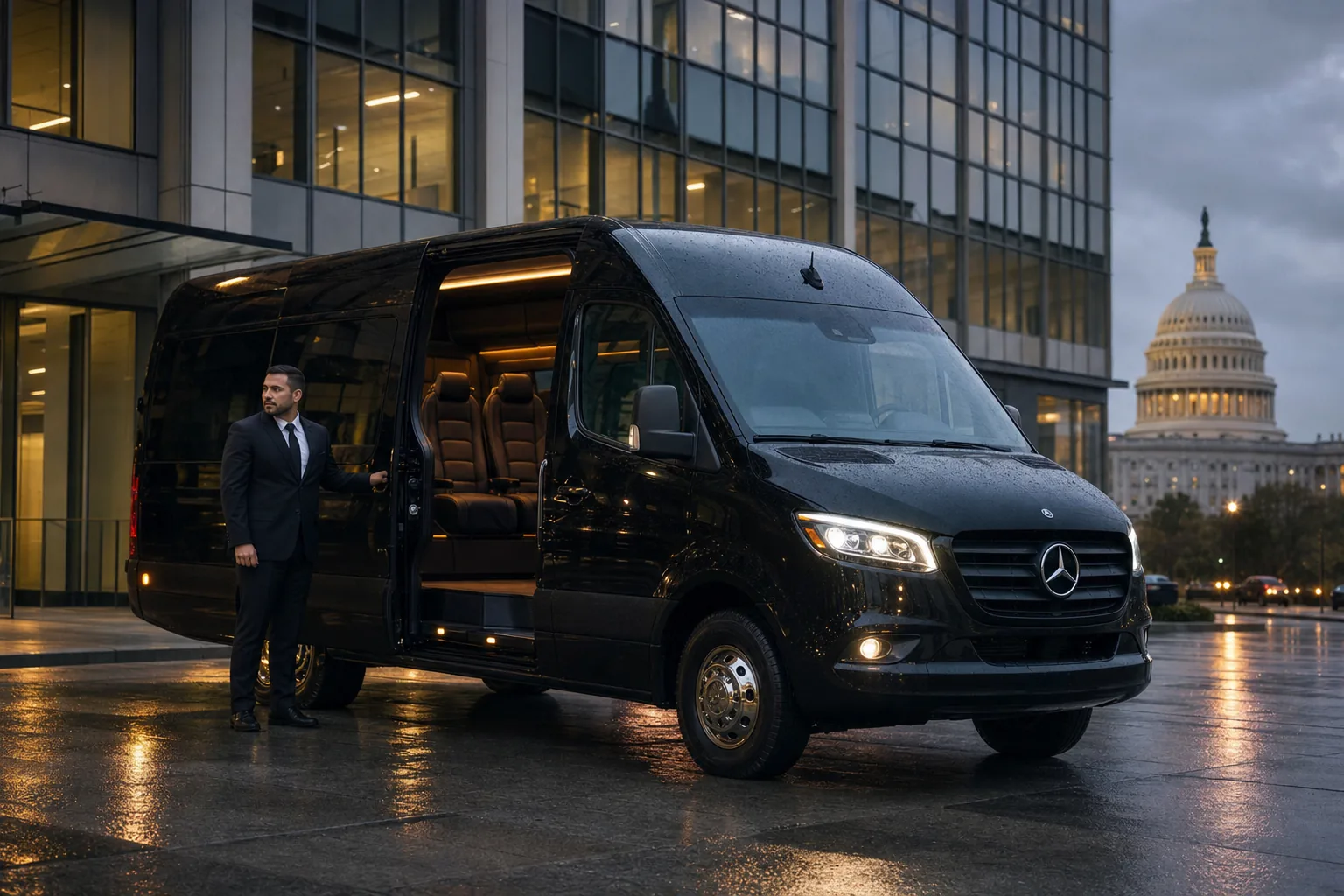
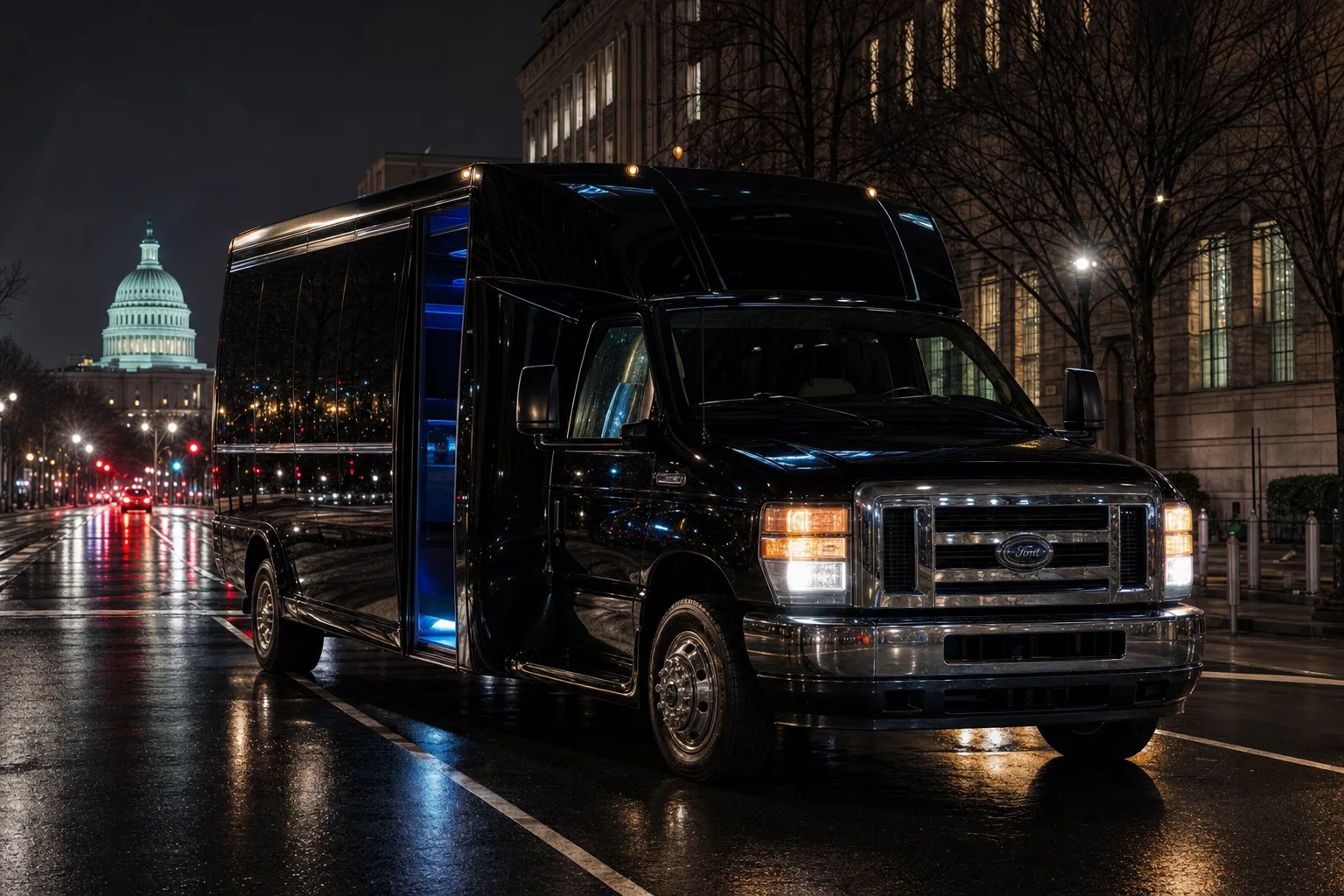
For six people or fewer making one simple trip, an XL is often the sensible, cheaper choice — request it and go. The calculation changes at seven. A group of twelve needs two to three XLs, three separate drivers, three arrival times, and split luggage, with surge priced three times over. Monarch moves the same group in one Sprinter Van at one flat price, together, with a vehicle that waits. Rideshare wins on spontaneity and small-group cost. Monarch wins the moment the group must arrive as one.
Choose Monarch when…
Groups of seven or more traveling as one party
Airport arrivals with real luggage — one vehicle, one curb, one departure
Weddings and events needing a vehicle on standby for hours
Conference and team movements up to 55 passengers on one booking
Choose Rideshare (UberXL/Lyft XL) when…
Six or fewer passengers on a single, simple trip
Spontaneous rides where cost matters more than arriving together
Light-luggage city hops where splitting the group is no burden
Overview
The Arithmetic of a Group
UberXL and Lyft XL each seat up to six passengers. Washington XL rates run roughly $2.50 per mile plus per-minute charges, and an XL from Dulles to downtown typically lands between $65 and $95 before surge. For twelve to fourteen people that means two to three vehicles per leg — $130 to $285 one-way from IAD — plus three requests, three drivers to track, and luggage divided across cars already holding six riders each.
Monarch treats the group as one movement. A 13-passenger Sprinter Van runs $661.50 flat point-to-point up to fifty miles, or $932.40 for a four-hour charter; a 42-passenger mini bus is $980 flat point-to-point. One vehicle, one chauffeur, one all-inclusive price with no surge, quoted in advance and held for seventy-two hours. On raw dollars, rideshare sometimes still wins. On arriving together, on time, with the luggage, it does not.
Side by Side
Monarch vs Rideshare, Factor by Factor
Feature
Monarch
Rideshare (UberXL/Lyft XL)
Pricing model
One flat all-inclusive price per vehicle; no surge; quote held 72 hours.
Metered per vehicle — base, per-mile, per-minute — multiplied by every XL you need, with surge on each.
Booking
One reservation covers the whole group; 50% deposit confirms.
One app request per vehicle per leg; large groups mean repeated requests all day.
Chauffeur vetting
Professional chauffeurs to one house standard.
Independent drivers meeting platform minimums; each vehicle brings a different one.
Vehicle consistency
The Sprinter, mini bus, or coach you book is what arrives.
Any qualifying 6-seat vehicle; model, size, and cargo space vary by driver.
Group capacity
12–13 in a Sprinter, 42 in a mini bus, 55 in a motor coach — one vehicle.
Six passengers per XL, hard ceiling; larger groups must split across cars.
Airport procedure
One confirmed vehicle scheduled against the flight; the group leaves the curb together.
Multiple XLs requested on landing from the rideshare curb; staggered arrivals and split luggage.
Cancellation
Free up to 48 hours before pickup.
Cancel in-app per ride; scheduled rides may carry fees, and supply is never guaranteed.
Billing and accounts
One receipt for the whole group.
Separate charges per vehicle per leg; reconciling a group day means stacks of receipts.
Local DMV knowledge
A DMV operator that stages group movements at DCA, IAD, and venues daily.
Varies by driver; no one is responsible for the group as a whole.
Real Numbers
What Real Trips Cost
Trip
Monarch
Rideshare (UberXL/Lyft XL)
Better fit
IAD to downtown DC, 12 guests with luggage
Rideshare can cost less in raw dollars; Monarch delivers the group to one curb, together, in one vehicle.
$661.50 flat, one Sprinter Van, point-to-point
Two to three UberXLs, typically $65–$95 each before surge — roughly $130–$285 total, with luggage split across full vehicles
Depends
Wedding shuttle, 14 guests, 4 hours
No rideshare product holds a vehicle for you; a wedding runs on a schedule surge does not respect.
$932.40 flat, Sprinter Van on standby all evening
Repeated XL requests per loop, typically $25–$45 per vehicle per hop before surge, with no vehicle on standby and evening surge likely
Monarch
Conference group of 40, hotel to venue
Seven separate drivers is not a transportation plan; one mini bus is.
$980 flat, one 42-passenger mini bus
Seven or more XLs per move, typically $20–$40 each per city hop — $140–$280+ per leg, re-requested and re-coordinated every time
Monarch
Monarch figures are exact published flat rates from the live rate card at monarchbusandlimo.com/rates. Competitor figures are typical ranges from public estimates and can move with demand.
Good to Know
Monarch vs Rideshare for Groups FAQs
How many passengers can UberXL take?
Six passengers is the ceiling for UberXL, and Lyft XL matches it. There is no rideshare tier above six, so a group of ten to fourteen must split into two or three vehicles with separate drivers, separate fares, and separate arrival times. Monarch's Sprinter Van carries thirteen in one vehicle, and the fleet extends to a 42-passenger mini bus and 55-passenger motor coach.
Is it cheaper to take multiple Ubers or rent a van with a driver?
For one simple leg, multiple XLs are often cheaper on paper — two to three Dulles runs at $65–$95 each versus Monarch's $661.50 flat Sprinter. The ledger shifts with surge, multiple legs, waiting time, and luggage. A four-hour charter at $932.40 buys a vehicle that stays, which no number of separate rideshare requests can replicate.
How do large groups get from Dulles to DC?
The practical options are splitting into multiple XLs, taking transit with luggage, or chartering one vehicle. For twelve with airport luggage, two to three XLs typically total $130–$285 before surge and divide the party across cars. Monarch's Sprinter Van is $661.50 flat point-to-point up to fifty miles — one scheduled vehicle meeting the flight, the whole group and its luggage together.
Does Uber have anything bigger than XL?
No. XL's six seats are the largest standard rideshare option in Washington; there is no rideshare Sprinter, shuttle, or bus tier. Groups beyond six must coordinate multiple vehicles themselves. Monarch fills that gap with a 12-passenger Sprinter Limo, 13-passenger Sprinter Van, stretch limousines to twenty, a 42-passenger mini bus, and a 55-passenger motor coach, each with a professional chauffeur.
Can you keep an Uber waiting during an event?
Not in any practical sense. Rideshare has no standby product; wait time is billed by the minute on an active trip, and drivers accept new fares once you exit. Every return leg is a fresh request at whatever price the evening demands. Monarch's hourly charters exist for exactly this — a Sprinter Van holds at your venue for four hours at $932.40 flat.
How much luggage fits in an UberXL?
An XL seating six passengers has little cargo room left — typically a few carry-ons once seats are filled, and the actual vehicle model varies by driver. Airport groups usually sacrifice seats for suitcases, which forces another vehicle. Monarch's Sprinter Van is built for exactly this load: thirteen passengers and their full airport luggage in one vehicle, confirmed in advance.
Ready to Switch?
Reserve a Flat-Rate Chauffeur Instead
Move your group as one. Request a fixed Sprinter or mini bus quote from Monarch.
UberXL and Lyft XL carry six passengers each. Past that number, rideshare stops being one decision and becomes a logistics problem. This is the math.
The Verdict
For six people or fewer making one simple trip, an XL is often the sensible, cheaper choice — request it and go. The calculation changes at seven. A group of twelve needs two to three XLs, three separate drivers, three arrival times, and split luggage, with surge priced three times over. Monarch moves the same group in one Sprinter Van at one flat price, together, with a vehicle that waits. Rideshare wins on spontaneity and small-group cost. Monarch wins the moment the group must arrive as one.
Choose Monarch when:
Groups of seven or more traveling as one party
Airport arrivals with real luggage — one vehicle, one curb, one departure
Weddings and events needing a vehicle on standby for hours
Conference and team movements up to 55 passengers on one booking
Choose Rideshare (UberXL/Lyft XL):
Six or fewer passengers on a single, simple trip
Spontaneous rides where cost matters more than arriving together
Light-luggage city hops where splitting the group is no burden
The Arithmetic of a Group
UberXL and Lyft XL each seat up to six passengers. Washington XL rates run roughly $2.50 per mile plus per-minute charges, and an XL from Dulles to downtown typically lands between $65 and $95 before surge. For twelve to fourteen people that means two to three vehicles per leg — $130 to $285 one-way from IAD — plus three requests, three drivers to track, and luggage divided across cars already holding six riders each.
Monarch treats the group as one movement. A 13-passenger Sprinter Van runs $661.50 flat point-to-point up to fifty miles, or $932.40 for a four-hour charter; a 42-passenger mini bus is $980 flat point-to-point. One vehicle, one chauffeur, one all-inclusive price with no surge, quoted in advance and held for seventy-two hours. On raw dollars, rideshare sometimes still wins. On arriving together, on time, with the luggage, it does not.
Monarch vs Rideshare, Factor by Factor
Factor
Monarch
Rideshare (UberXL/Lyft XL)
Pricing model
One flat all-inclusive price per vehicle; no surge; quote held 72 hours.
Metered per vehicle — base, per-mile, per-minute — multiplied by every XL you need, with surge on each.
Booking
One reservation covers the whole group; 50% deposit confirms.
One app request per vehicle per leg; large groups mean repeated requests all day.
Chauffeur vetting
Professional chauffeurs to one house standard.
Independent drivers meeting platform minimums; each vehicle brings a different one.
Vehicle consistency
The Sprinter, mini bus, or coach you book is what arrives.
Any qualifying 6-seat vehicle; model, size, and cargo space vary by driver.
Group capacity
12–13 in a Sprinter, 42 in a mini bus, 55 in a motor coach — one vehicle.
Six passengers per XL, hard ceiling; larger groups must split across cars.
Airport procedure
One confirmed vehicle scheduled against the flight; the group leaves the curb together.
Multiple XLs requested on landing from the rideshare curb; staggered arrivals and split luggage.
Cancellation
Free up to 48 hours before pickup.
Cancel in-app per ride; scheduled rides may carry fees, and supply is never guaranteed.
Billing and accounts
One receipt for the whole group.
Separate charges per vehicle per leg; reconciling a group day means stacks of receipts.
Local DMV knowledge
A DMV operator that stages group movements at DCA, IAD, and venues daily.
Varies by driver; no one is responsible for the group as a whole.
What Real Trips Cost
Trip
Monarch
Rideshare (UberXL/Lyft XL)
IAD to downtown DC, 12 guests with luggage
$661.50 flat, one Sprinter Van, point-to-point
Two to three UberXLs, typically $65–$95 each before surge — roughly $130–$285 total, with luggage split across full vehicles
Wedding shuttle, 14 guests, 4 hours
$932.40 flat, Sprinter Van on standby all evening
Repeated XL requests per loop, typically $25–$45 per vehicle per hop before surge, with no vehicle on standby and evening surge likely
Conference group of 40, hotel to venue
$980 flat, one 42-passenger mini bus
Seven or more XLs per move, typically $20–$40 each per city hop — $140–$280+ per leg, re-requested and re-coordinated every time
Monarch vs Rideshare for Groups FAQs
How many passengers can UberXL take?
Six passengers is the ceiling for UberXL, and Lyft XL matches it. There is no rideshare tier above six, so a group of ten to fourteen must split into two or three vehicles with separate drivers, separate fares, and separate arrival times. Monarch's Sprinter Van carries thirteen in one vehicle, and the fleet extends to a 42-passenger mini bus and 55-passenger motor coach.
Is it cheaper to take multiple Ubers or rent a van with a driver?
For one simple leg, multiple XLs are often cheaper on paper — two to three Dulles runs at $65–$95 each versus Monarch's $661.50 flat Sprinter. The ledger shifts with surge, multiple legs, waiting time, and luggage. A four-hour charter at $932.40 buys a vehicle that stays, which no number of separate rideshare requests can replicate.
How do large groups get from Dulles to DC?
The practical options are splitting into multiple XLs, taking transit with luggage, or chartering one vehicle. For twelve with airport luggage, two to three XLs typically total $130–$285 before surge and divide the party across cars. Monarch's Sprinter Van is $661.50 flat point-to-point up to fifty miles — one scheduled vehicle meeting the flight, the whole group and its luggage together.
Does Uber have anything bigger than XL?
No. XL's six seats are the largest standard rideshare option in Washington; there is no rideshare Sprinter, shuttle, or bus tier. Groups beyond six must coordinate multiple vehicles themselves. Monarch fills that gap with a 12-passenger Sprinter Limo, 13-passenger Sprinter Van, stretch limousines to twenty, a 42-passenger mini bus, and a 55-passenger motor coach, each with a professional chauffeur.
Can you keep an Uber waiting during an event?
Not in any practical sense. Rideshare has no standby product; wait time is billed by the minute on an active trip, and drivers accept new fares once you exit. Every return leg is a fresh request at whatever price the evening demands. Monarch's hourly charters exist for exactly this — a Sprinter Van holds at your venue for four hours at $932.40 flat.
How much luggage fits in an UberXL?
An XL seating six passengers has little cargo room left — typically a few carry-ons once seats are filled, and the actual vehicle model varies by driver. Airport groups usually sacrifice seats for suitcases, which forces another vehicle. Monarch's Sprinter Van is built for exactly this load: thirteen passengers and their full airport luggage in one vehicle, confirmed in advance.